One YAML file is the airplane
design/baseline.yaml holds geometry, engine candidates, materials, recovery, launcher, avionics and cost inputs. Every model reads it through dart.config.load(), and nothing is allowed to hard-code a value that lives there. Changing the file changes the design hash; the aero tables rebuild, cached by geometry hash, and each study writes a manifest under runs/ with the design hash, inputs, git revision, tool versions, wall and CPU time, and results. 95 manifests exist across 28 studies.
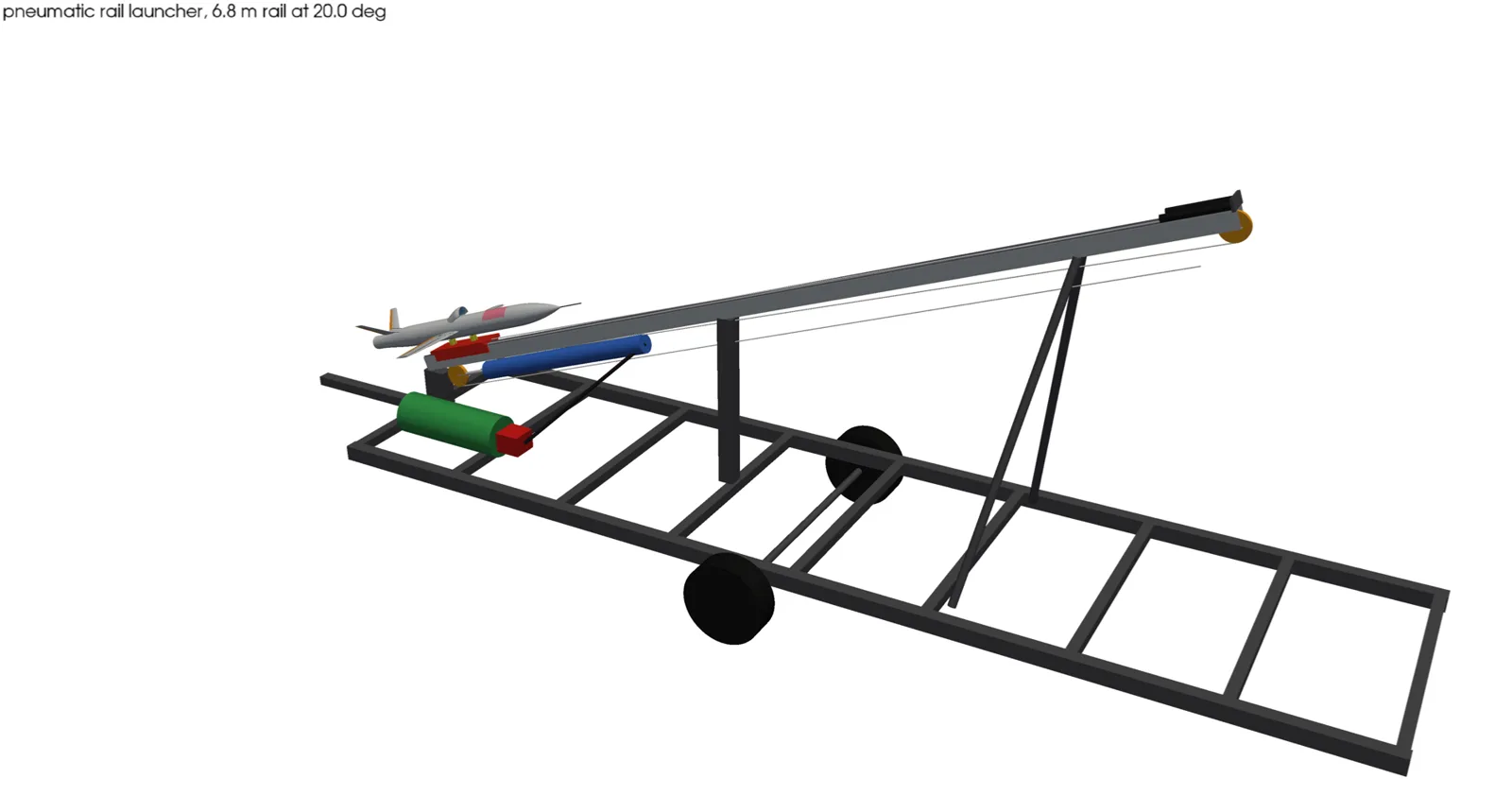
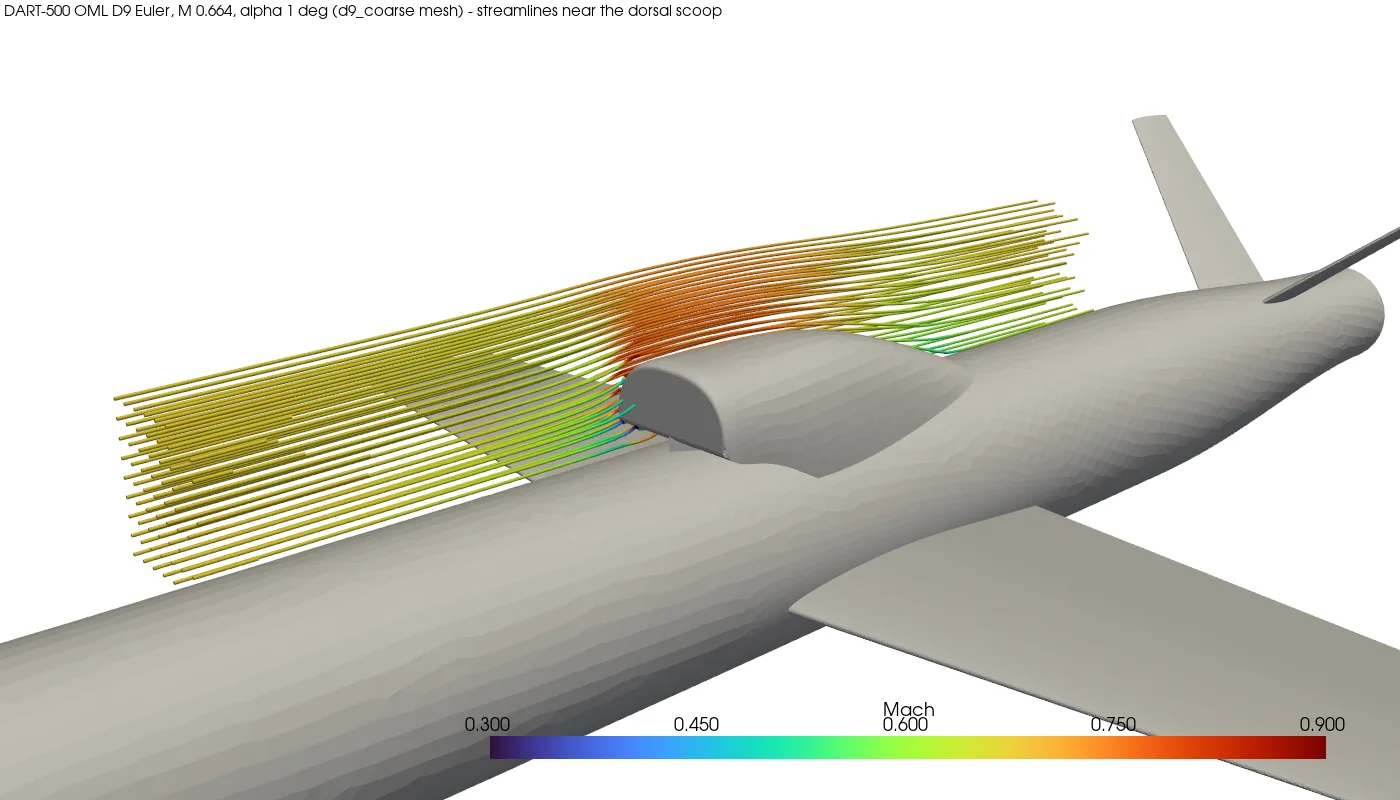
The design history is the git history of that one file. D2 took a 6 L tank and a 4 g, 800 m run-in profile from the engine-by-tank trade. D3 sized the launcher. D4 picked 4 N m flaperon servos after the hinge-moment estimate came out at 0.64 N m per degree at 500 mph. D8 switched recovery to a steerable parafoil. D9 set the inlet capture area to 0.0043 m² with a 13 mm boundary-layer diverter, straight out of the CFD study. Each commit names the study that drove it.
Cheap models explore, expensive ones check
Fast models do the design search: AeroBuildup tables with Korn/Lock transonic drag, a corrected-speed turbojet cycle fitted to the JetCat P400 datasheet, beam and typical-section structures, a pneumatic launcher with orifice flow. SU2 checks the consequential points. The 2D solver was benchmarked against RAE 2822 (lift within 1.6 percent), the Korn factor was calibrated to SU2 sweeps of the NACA 64A sections (κ = 0.90), and a 3D Euler half-model landed lift slope within 1.5 percent and the neutral point 0.8 cm from the fast model.
The CFD also caught a real problem. At cruise the dorsal scoop had a supersonic pocket and 24.5 N of spillage drag, against a hand estimate of about 4 N, which meant the D7 drag figure was roughly 10 percent optimistic. The D9 inlet cut the supersonic volume by 89 percent and spillage drag to about zero. A lip-crest peak of M1.19 and a dive pocket remain open, and the docs say so.
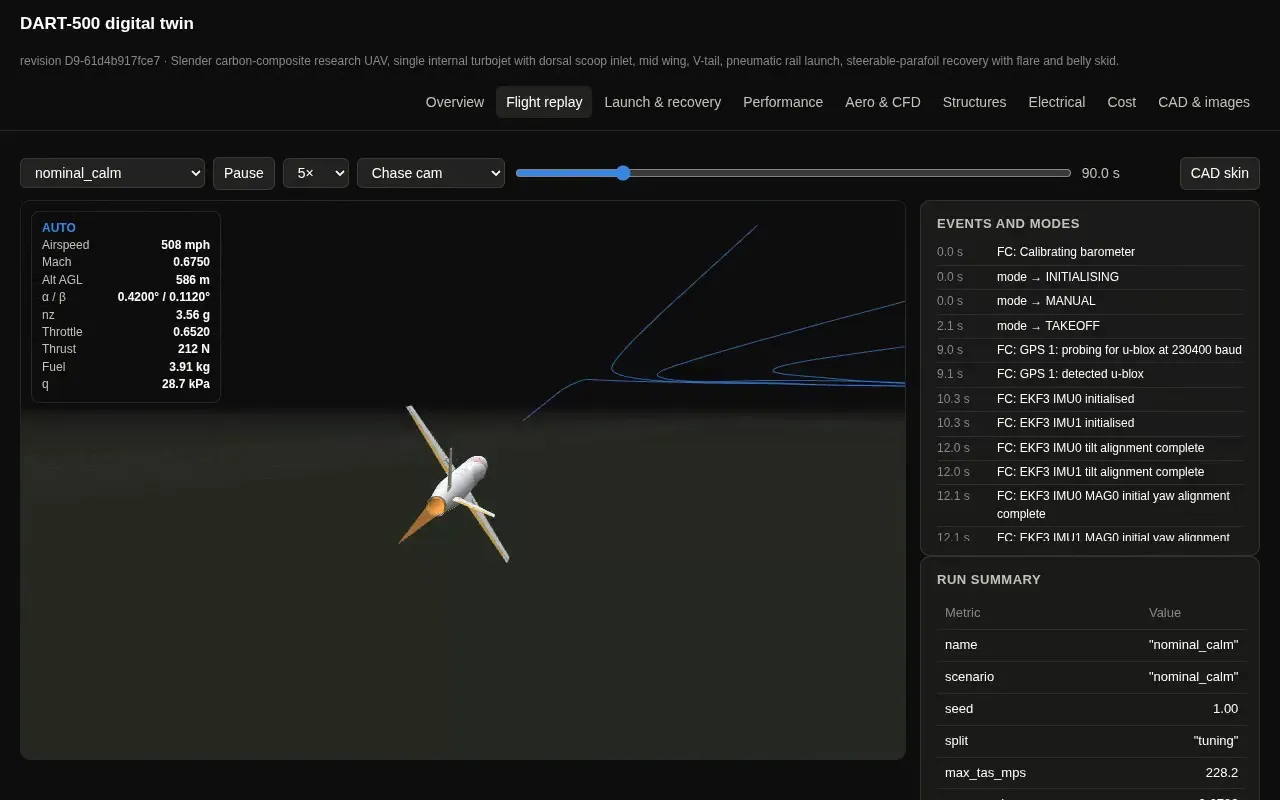
The flight model flies the real autopilot
A 6-DoF model with actuator hinge-moment stall and Dryden turbulence talks to ArduPlane 4.7.2 through its JSON bridge, so the autopilot being tuned is the one that would fly. The campaign ran 10 tuning cases and 5 held-out cases that were never used for tuning: speed runs, flameout at speed, GPS and link loss, a blocked airspeed sensor, a stuck ruddervator, geofence termination, crosswind launch.
Everything in the air passed. What remained was recovery: touchdowns in drift (45 to 55 g on the round canopy and airbags) and fuel reserve in turbulence, which is what the parafoil selection answers. The campaign also showed that ArduPlane has no load-factor limiter: turn entries near 200 m/s pulled 9.5 to 10.5 g until I set a 13 deg/s pitch-rate limit, and the stuck-ruddervator departure reached 11.8 g. A g-limiter is now a precondition for flight above 150 m/s.
Built as parallel workstreams, integrated on main
CAD, CFD, SITL, electrical, launch and recovery, and later flutter ran as separate workstreams on their own branches and git worktrees, merged into main as integration snapshots. The rules were written down: read the design only through the config loader, propose design changes with evidence instead of editing them, run anything over three minutes as a resource-capped systemd unit, keep scratch off the nearly full code volume. The electrical stream produced a schematic and PCB for the power, interface and termination board with ERC and DRC at zero errors, five circuit sims and twelve firmware tests; it still has 38 unrouted connections. A static dashboard pulls it together, including a 3D twin that replays every SITL run with hinged surfaces.
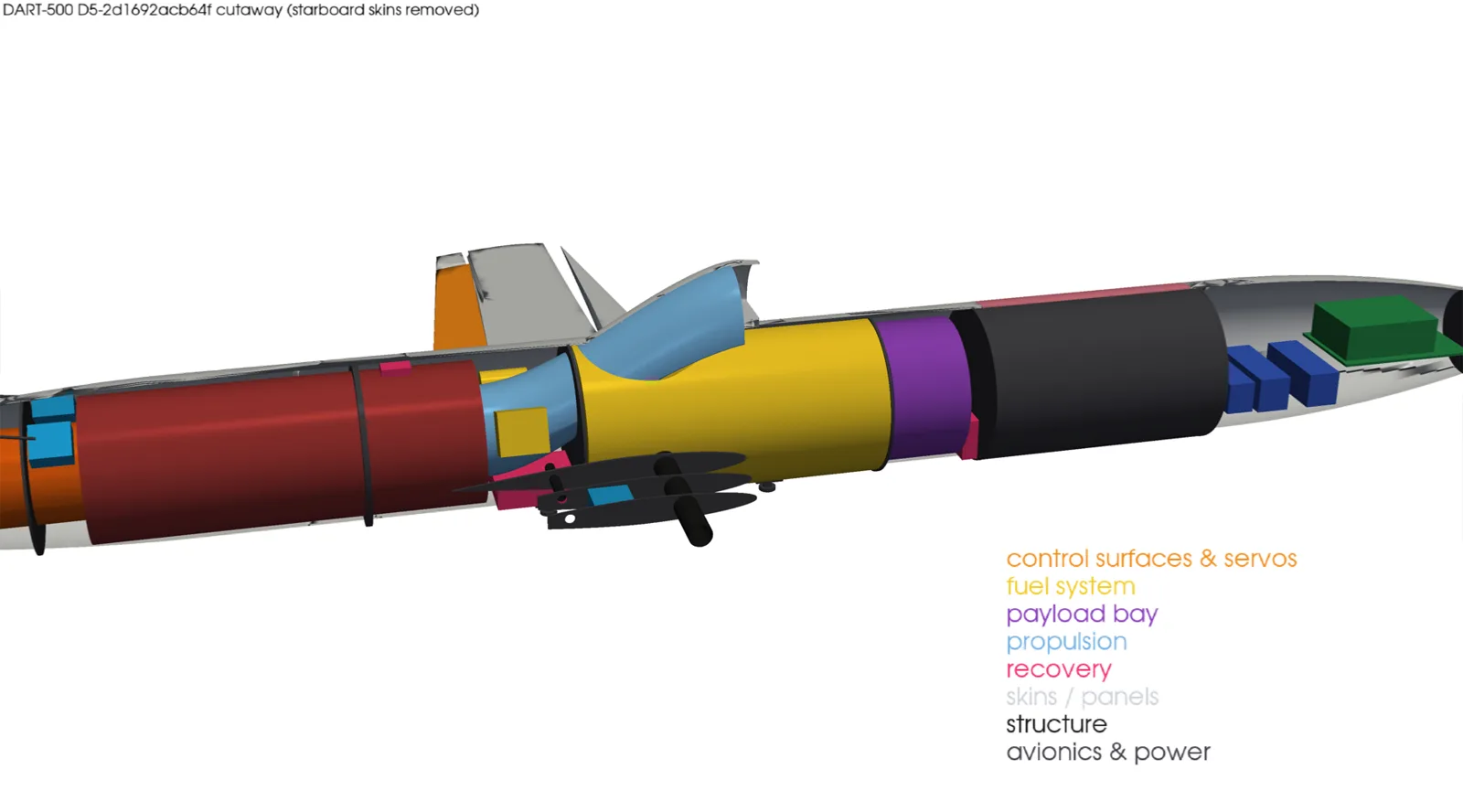
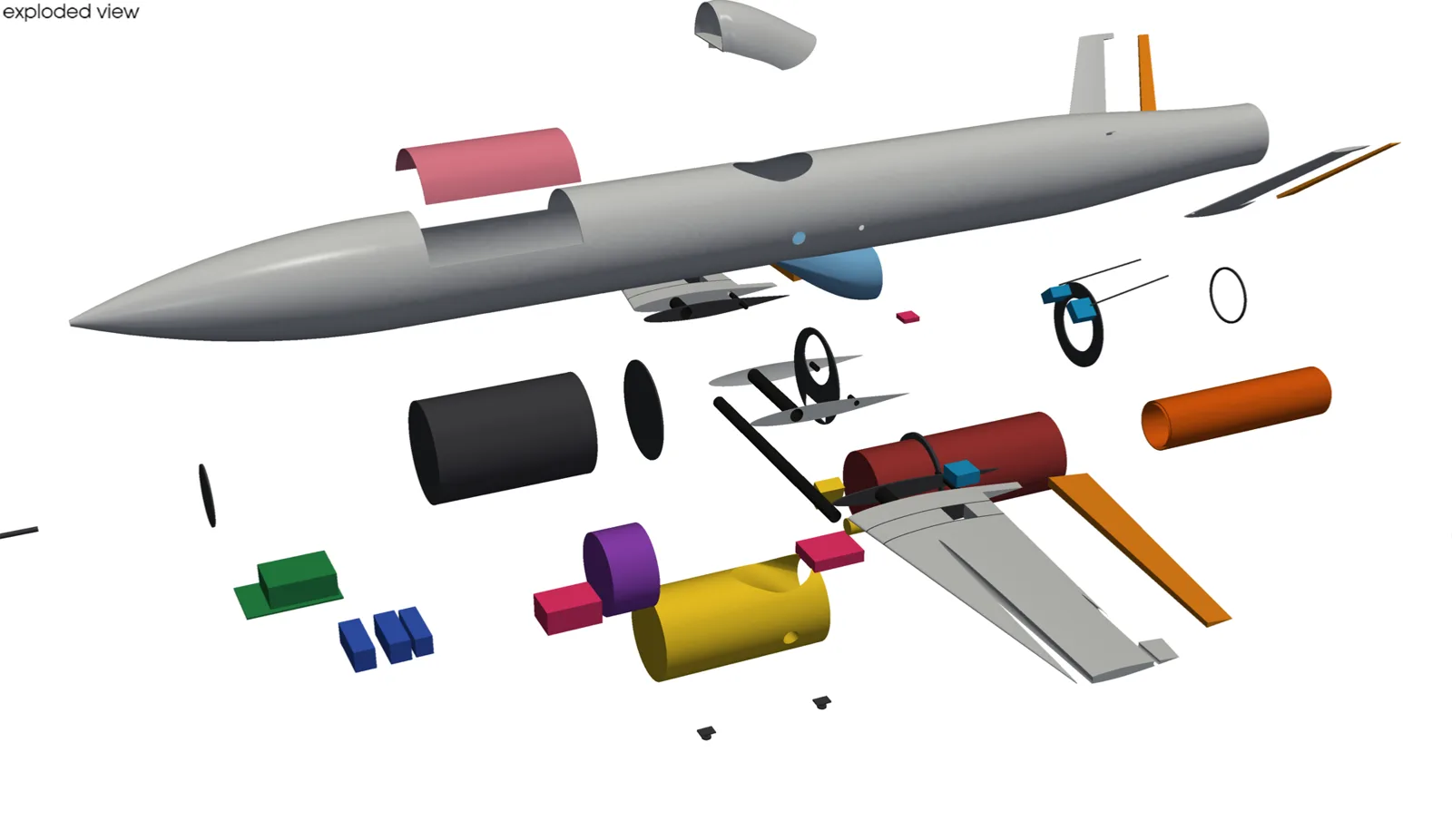
How the pieces connect
Decisions, and what I gave up for them
Steerable parafoil over a round canopy and airbags
- CHOSE
- 5 m² steerable parafoil with a flare and belly skid (D8)
- OVER
- The D5 round reefed canopy with relief airbags
- WHY
- The SITL campaign put the remaining margin in recovery: 45 to 55 g touchdowns with drift on the round canopy. The concept trade gives the parafoil 14.6 g worst-case touchdown up to 10 m/s wind and 99 percent usable mornings against ASOS wind climatology.
Launch below stall speed
- CHOSE
- An 8 m rail at 20 degrees that releases the aircraft at about 31 m/s, below stall
- OVER
- A longer or harder launcher that reaches flying speed on the rail
- WHY
- Thrust is about twice weight, so the aircraft keeps accelerating after release. The launch requirement is judged on the fly-out trajectory: no sink below the release point, at least 5 degrees of alpha margin, 1.2 times stall within 2 seconds.
Flaperon stiffness instead of mass balance
- CHOSE
- A 2:1 linkage and mid-span horn for at least 150 N m/rad hinge stiffness, no balance mass
- OVER
- Mass-balancing the flaperons
- WHY
- The 3-DOF Theodorsen analysis, validated against NACA Report 741, showed balancing costs 56 to 133 g per side and still needs high stiffness near torsion coincidence, and partial balance is worse than none.
Timeline
- 01:23 scaffold: config, requirements, run registry; D1 sized from core models by 01:41
- D2 to D5 overnight: tank, launcher, servos, round canopy and airbags
- ArduPlane SITL campaign on D7: every in-air case passes; recovery becomes the next design target
- D8: steerable parafoil, 8 m rail, CAD-fitted batteries
- D9: inlet resized from the CFD study; control-surface flutter workstream merged
- 22:19 cost model and dashboard verdicts on D9
Sources and method
Written from the project's code, documentation and commit history, reviewed in November 2026. Business figures come from me. Clips and screenshots are labelled with where they came from; none show customer data.
README.mddesign/baseline.yaml (git log)docs/data-gaps.mddocs/d10-pending.mddocs/workstream-rules.mddocs/test-plan.mdsrc/dart/launch.pysrc/dart/performance.pyviewer/app.jsruns/