What needed solving.
Free-form model-generated geometry is hard to reproduce and audit. The compiler constrains authoring to typed parameters, operations, datums, joints, and declared evidence, so unsupported or ambiguous requests fail with diagnostics instead of silently producing plausible geometry.
- 01Typed product intent
- 02Deterministic CAD lowering
- 03Artifacts + rechecked evidence
Simplified from the implementation and project notes.
How it fits together.
Compile intent into reviewable artifacts
The CAD pipeline accepts typed YAML/JSON, lowers supported primitives, profiles, booleans, transforms, sweeps, lofts, shells, and digest-bound STEP imports through build123d, then emits STEP, 3MF, SVG, preview, canonical specs, verification records, and content-addressed manifests. A certificate binds the program to the lowering result; verification recompiles and reruns registered checks instead of trusting a stored pass flag.
Constrain assembly composition
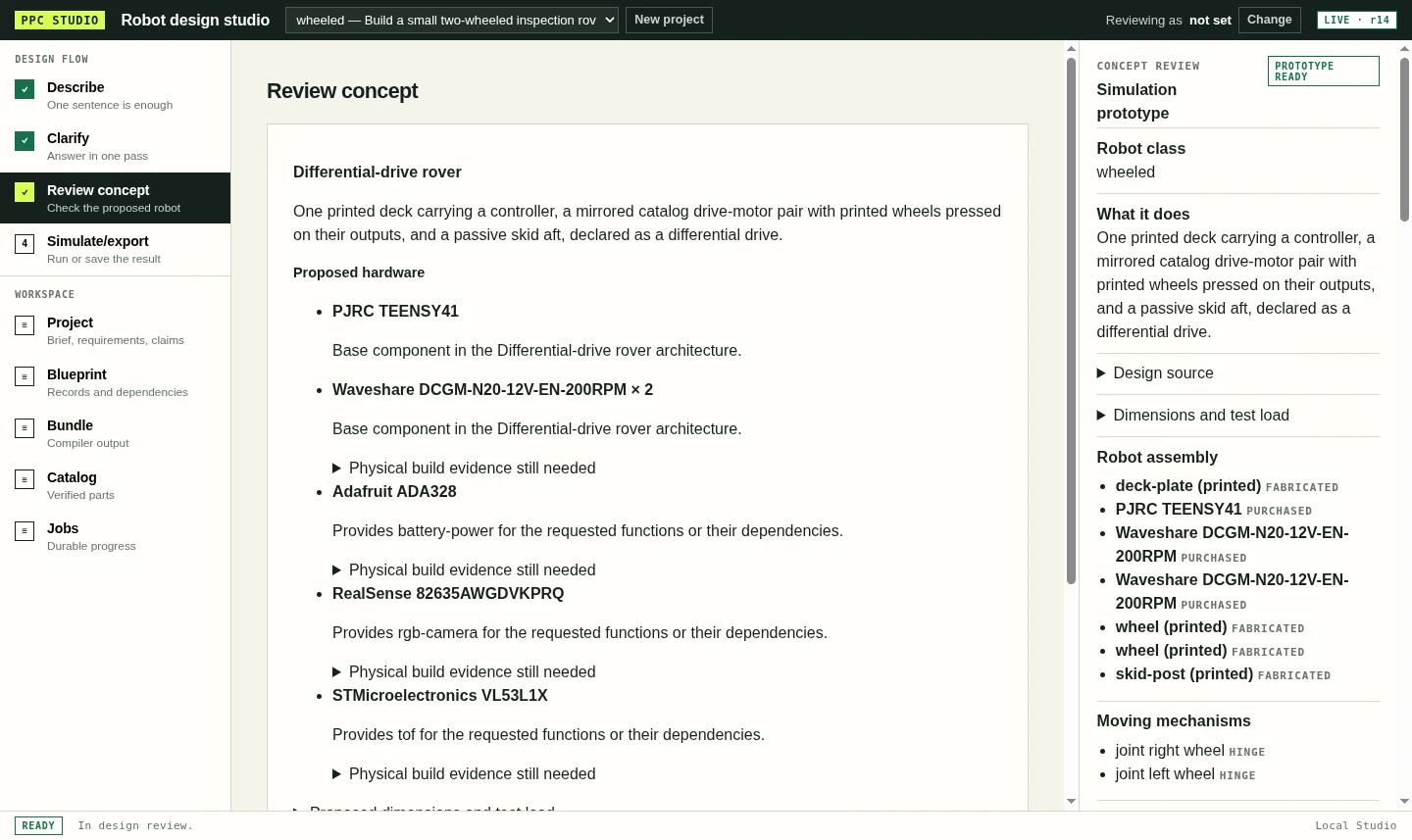
A Studio editor applies revision- and digest-bound edit batches transactionally. Design screens include nominal geometry, wall/hole probes, clearances, assembly mass, and sourced motor effort. A separate actuated-product schema adds mass properties, collision roles, dynamics, sensors, controllers, scenarios, BOM, assembly and wiring. The engine's composition contract intentionally removes arbitrary poses: typed datums derive transforms and mates; illegal or ambiguous combinations are refused.
Rebuild before claiming a pass
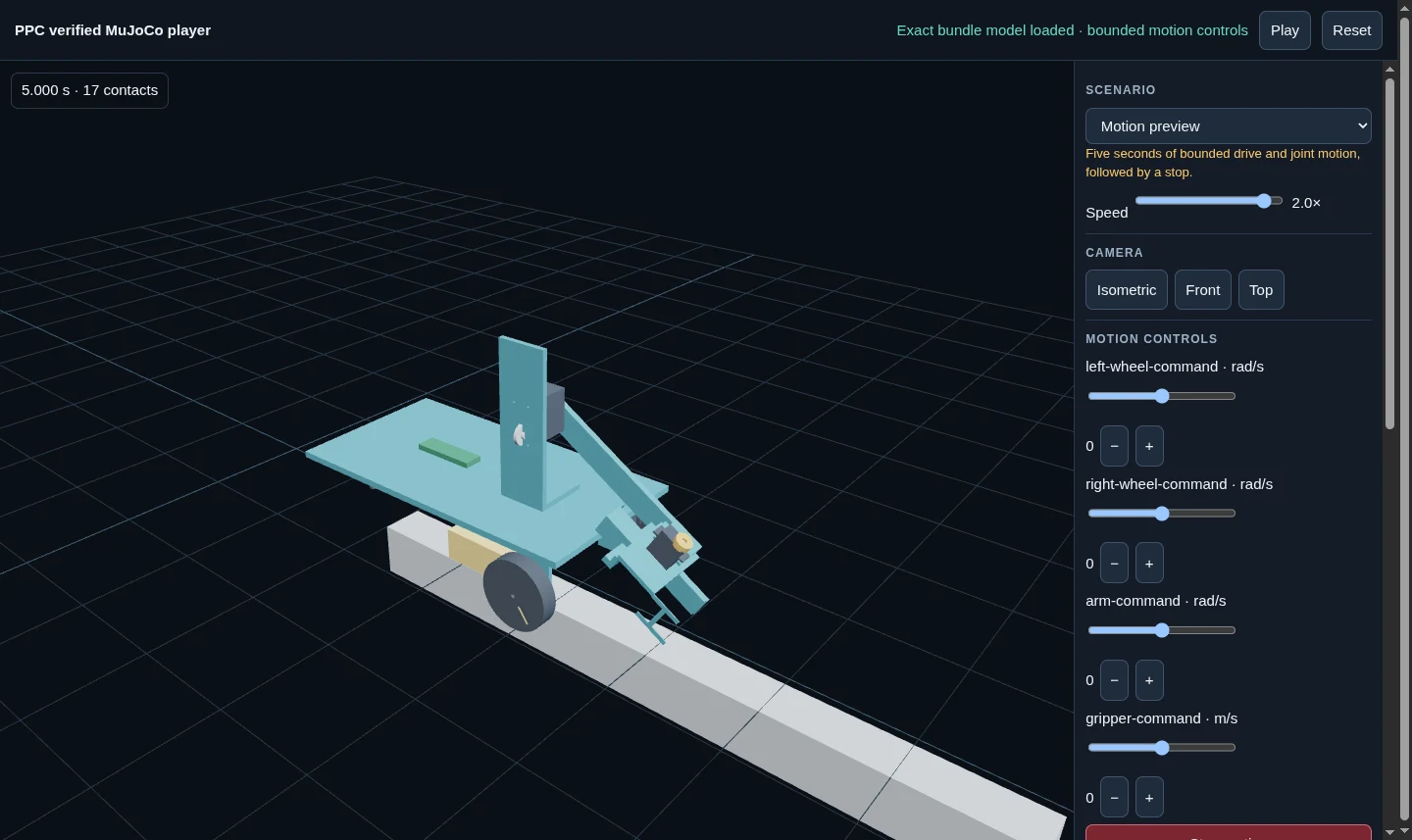
The Butter Bot is a supervised tabletop robot example with a hardware intent, bill of materials, firmware/controller path, simulation scenarios and fabrication artifacts. Documentation records simulation acceptance and a first-build preparation workflow; it carefully distinguishes model results from physical results. The compiler also labels unverified slicing and unsupported physical behavior as unknown rather than pass.
Building and checking it.
A user or model supplies requirements and structured intent, resolves ambiguity, previews changes, then compiles and verifies a bundle. Human edits and model proposals share the same transaction schema; model changes arrive as previews and cannot replace requirements or print settings. Users can simulate declared motion, inspect evidence, and export part files and fabrication metadata.
For the Butter Bot path, the documented sequence is requirements and machine profile, fit coupons, slice oriented parts, assemble and commission under supervision, then perform the prescribed physical task. The recorded native/browser task runs are simulation evidence; the physical build and lift/repeatability tests are not reported as completed.
Supported CAD operations and actuated hardware profiles are deliberately bounded. Nominal geometry, a successful build, discrete motion samples, and even successful slicing do not establish strength, fit, thermal behavior, continuous-motion clearance, or physical performance. Generic printer settings lack machine calibration evidence. The first physical acceptance targets remain unmeasured.
Source notes
Based on repository code and project records reviewed on October 30, 2026. Historical checks are described as recorded, not rerun for this article. Screenshots, renders, and mockups are labeled individually.
physical-product-compiler/README.mdphysical-product-compiler/pyproject.tomlphysical-product-compiler/docs/engine-v1-contract.mdphysical-product-compiler/docs/stable-v1-acceptance.mdphysical-product-compiler/docs/butter-bot-first-build.md