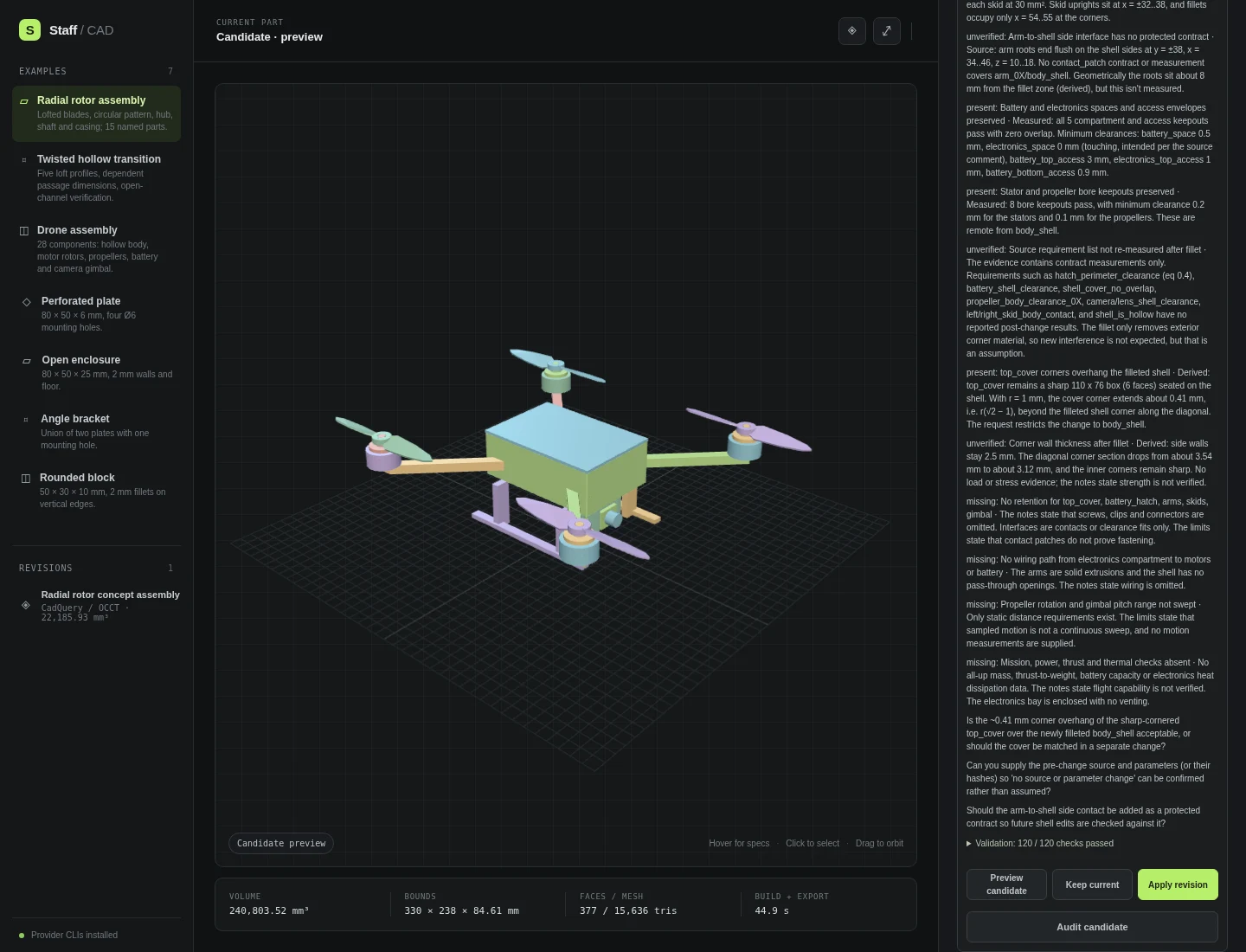
What needed solving.
CAD agents can miss requirements, damage interfaces, or optimize a proxy while degrading useful geometry. These experiments test whether an AI can discover omissions and revise a design while host-side geometry checks preserve artifacts and enforce acceptance boundaries.
- 01Frozen requirements
- 02Model proposal + sandboxed build
- 03Independent geometry checks
Simplified from the implementation and project notes.
How it fits together.
The report records 10 live model calls and 21 sequential sandboxed builds against a prototype revision. Experiments included requirement audits for a drone and enclosure, battery-driven parameter changes, an unseen battery repair, a structured fillet operation, rollback on a failed multi-edit transaction, and bounded cost search. The model returned parameters or typed operation intent; fixed host code selected edges, built geometry, and ran acceptance checks.
The validation combined native requirements, shape-difference/dependency checks, non-overlap, extraction sweeps, motion probes, contact-area measurements, and independently frozen spatial envelopes. Transaction tests compared revision pointers and artifact hashes after a valid edit followed by an invalid one. Cost candidates were ranked under fixed assumptions, and a negative control demonstrated why design-relative checks alone can shrink with the design.
The findings are mixed and technically specific: the planner predicted affected components and repaired one unseen battery fit, but an unchanged gimbal contact patch shrank; one lower-cost candidate consumed margin and reduced skid contact; a stronger independent envelope caught a candidate that passed all original checks. The model also correctly refused an infeasible constraint combination after the inequalities were supplied.
Building and checking it.
Each experiment starts from a fixed design and prompt, runs the model through a sandboxed structured workflow, rebuilds through host-controlled CAD, then evaluates native and independent criteria. Results, prompts, artifacts, and an independent rubric are retained for review. A failed candidate can be revised, but a relaxed request is called out rather than presented as the original requirement passing.
This is a research harness, not a product API. The report recommends adding explicit interface contracts, separating physical requirements from construction parameters, using staged atomic revisions, and exposing cost alongside fit, contact, and manufacturing margins.
Small pilot, not a reliability benchmark; calls used more than one model and do not support provider ranking. The test controller is external to the product checkout, only one semantic operation was implemented, and geometry checks cannot establish strength, tolerance, sliced time, or print performance. Search results are lowest measured among a small candidate set, not a general optimum.
Source notes
Based on repository code and project records reviewed on October 30, 2026. Historical checks are described as recorded, not rerun for this article. Screenshots, renders, and mockups are labeled individually.
cad-autonomy-experiments/REPORT.mdcad-autonomy-experiments/final-review.mdcad-autonomy-experiments/independent-rubric.mdcad-autonomy-experiments/run.pycad-autonomy-experiments/followup.py