What needed solving.
A claim about AI expanding creative and technical ability is more useful when readers can inspect examples and manipulate the idea themselves.
- 01Sourced examples
- 02Editorial + interactive models
- 03Static journal + manifesto
Simplified from the implementation and project notes.
How it fits together.
The site uses static route exports for the manifesto and journal. Client-side interactive modules provide topic-specific demonstrations without requiring accounts or a server-side data layer.
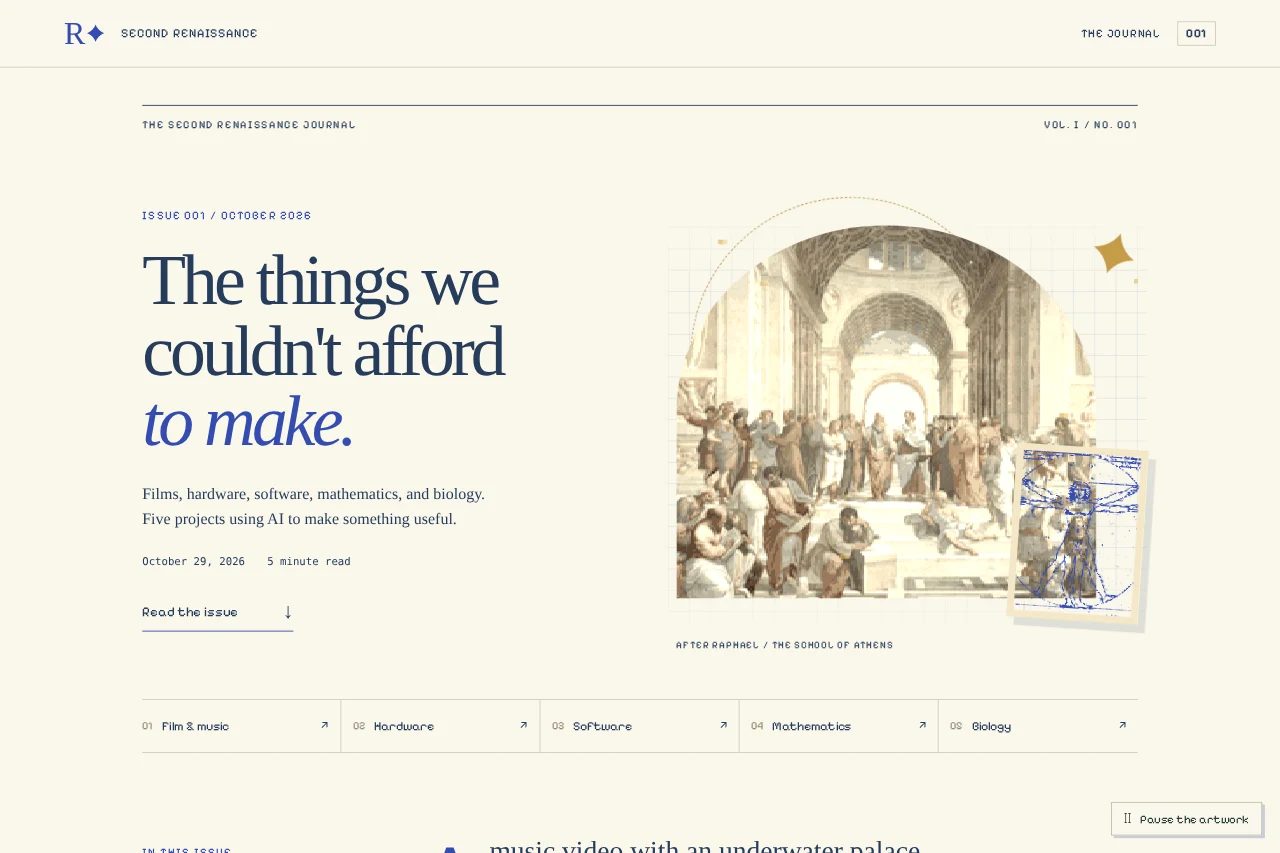
The visual system combines self-hosted pixel typography, public-domain art derivatives, layered CSS motion, reading progress, and chapter navigation. Pointer effects are bounded and stop when idle, hidden, paused, or reduced motion is requested.
The journal’s mobile interactions account for touch input and constrained viewports. Links lead to source examples, with demonstrated capabilities distinguished from aspirations.
Building and checking it.
The editorial workflow starts with concrete examples, rewrites the argument around what those examples support, and adds an interactive model where manipulating a parameter teaches more than a paragraph.
Static builds keep publication simple. Motion controls and reduced-motion support are part of the experience rather than an afterthought.
The interactive explanations are educational models, not scientific validation of the linked tools. The current site is a publication; newsletter delivery and subscriptions are not implemented.
Source notes
Based on repository code and project records reviewed on October 30, 2026. Historical checks are described as recorded, not rerun for this article. Screenshots, renders, and mockups are labeled individually.
second-renaissance/README.mdsecond-renaissance/app/journal/001/page.tsx